

52 BC – the seat of Avaricum
« The most beautiful city in the whole of Gaul ». Julius Caesar - The Gauls' War.
When césar assiège buds
In 52 B.C., Julius Caesar is seated Avaricum, the capital of the Bituriges Cubes, in the heart of the Berry.
In La Guerre des Gaules, he describes the city as « One of the most beautiful and strong cities in the whole of Gaul ».
A fortress city
Protected by a powerful stone and wood rampart, Avaricum is an organized oppidum with streets, squares and a natural position difficult to attack.
Falling: A Bloodbath
Seating equipment — Ballists, catapults, onagres — The city is taken.
In the area of the present St. Stephen's Cathedral, in the heart of the historic centre of Bourges, the massacre sank upon the population.
Approximately 40,000 people are killed. Only a few hundred souls — about 800 — manage to escape.
Avaricum is destroyed, between the marshes of Yèvre and Auron.
A military feat
Despite the cold, the rain and the Gaulish resistance, Caesar imposed hard work on his legions.
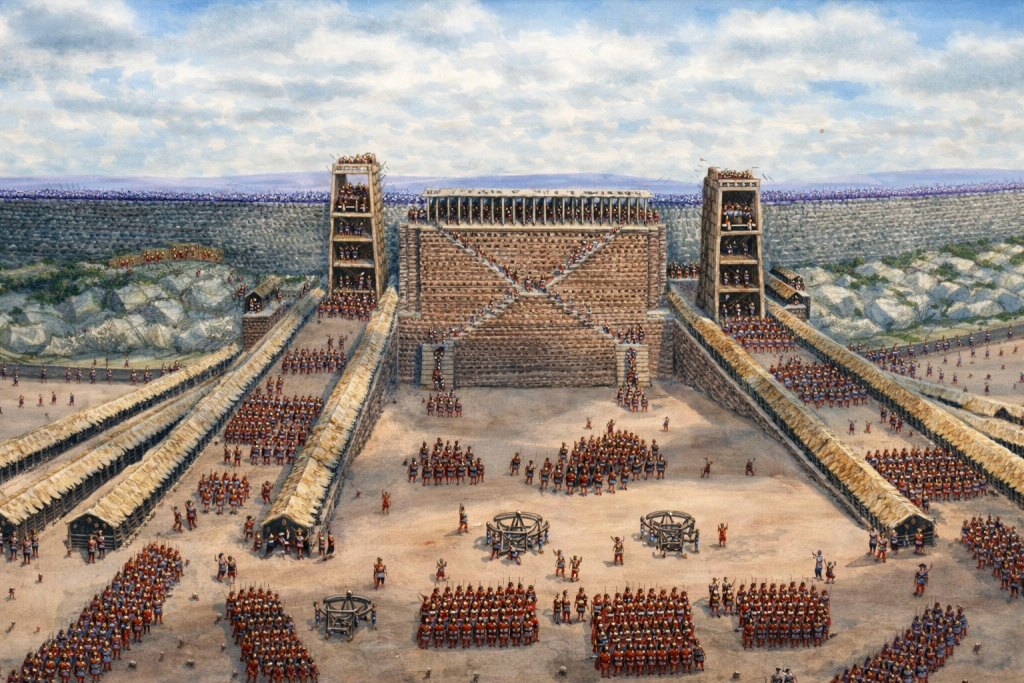
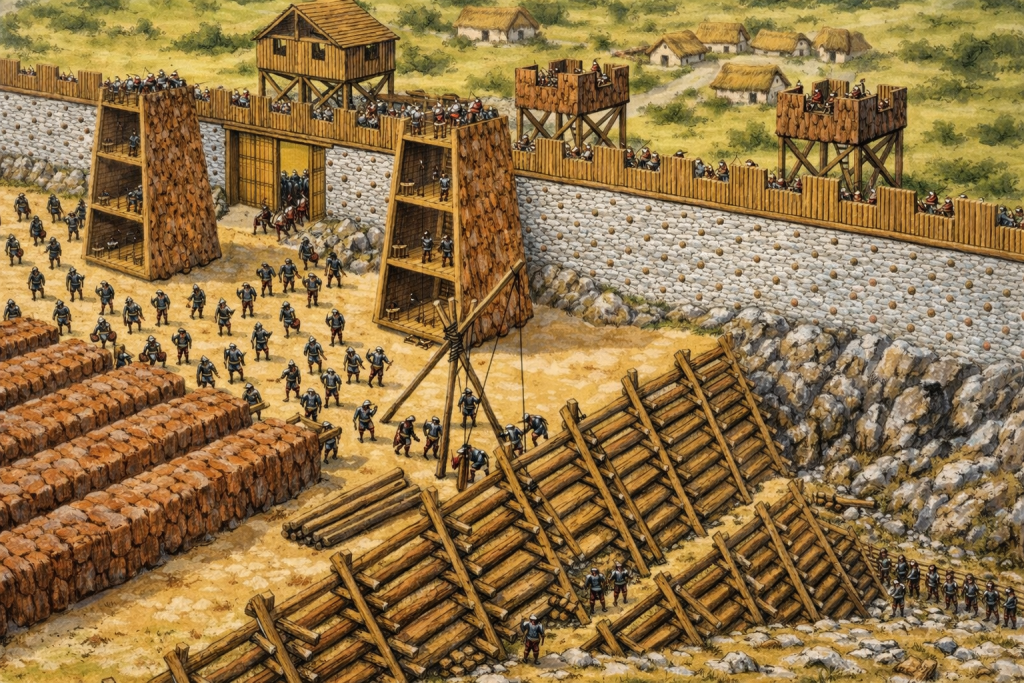
In 25 days, the Romans built a huge assault terrace (agger), 100 meters wide and 27 meters high, almost in contact with the rampart.
A memory buried
The rebuilt Roman city erases almost any Gaulish trace. Today there are only traces of the bulwark ditch, probably located in the area of the Archdiocese Garden.
Avaricum remains a strong symbol:
- of the Gaulish Resistance
- Roman rule
When Bourges was called Avaricum
The Bourges site has been occupied for a long time. The hill, between the valleys of Auron and Yèvre, which was very swampy, was suitable for habitation and defense. If evidence of prehistory is attested by archaeological excavations, as well as records of missing menhirs and dolmens, it is only in the Iron Age (Hallstatt) that an agglomeration has been established. It was a princely residence, given the furniture found, especially near Littré College (Greek ceramics) and the tombs of Lazenay.
An artisanal district was located on the site of Port-Sec, habitats in various sectors. In 52 B.C., Julius Caesar assiège Avaricum, quoted in his « Gauls' War » (De Bello Gallico), his first appearance in the texts. It was the capital of the people of the Bituriges Cubes, which occupied a territory almost likeable in Berry. Caesar considers it to be « a city which is, or little is necessary, the most beautiful of all Gaul, which is the strength and ornamentation of their country ». This oppidum, surrounded by a bulwark of which it details the construction of stone and wood (murus gallicus), protected a city with streets and squares. Avaricum's population was massacred by assault ramps and war machines. The establishment of a Roman city on the same site has completely eliminated the Gaulish traces, except for a small part of the ditch bordering the rampart.
The new city presented all the characteristics of Roman urban planning, with part of its orthonormous plan, and monumental buildings, temples, amphitheatre, cryptoportic, thermal, aqueducts and fountains. Avaricum was one of the major agglomerations of Gaul from the 1st to the 3rd century. Then, in the fourth, it was enclosed in a reinforced wall of about forty towers and opened four doors, a much smaller area, about twenty-five hectares. This enclosure was built on the stones of the monumental buildings, on which was built a wall made of small bricks.
Philippe Goldman
Avaricum, a drawing memory from father to son
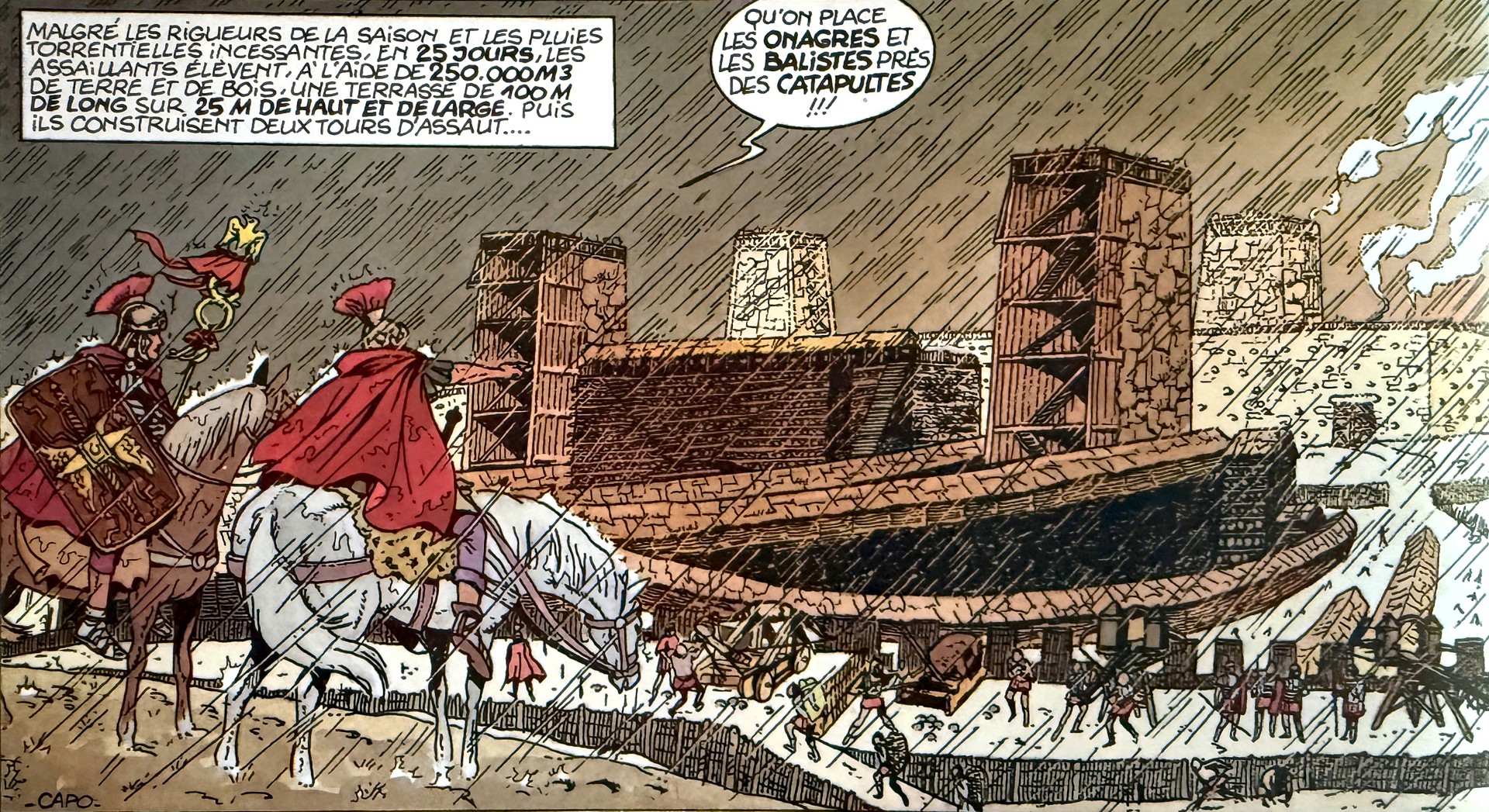
Through these two representations of the headquarters of Avaricum, the same story is passed on from generation to generation. In 1958, Michel Capo gave his vision of this major episode of the history of Bourges in an ink drawing of China. Almost seventy years later, his son Bernard Capo inspired his father's work and performance to design his own board in the album. The Great Hours of Bourges. Two looks, two epochs, but the same attachment to the memory of the Berruyère city, in an artistic filiation where history and gesture are transmitted from father to son.
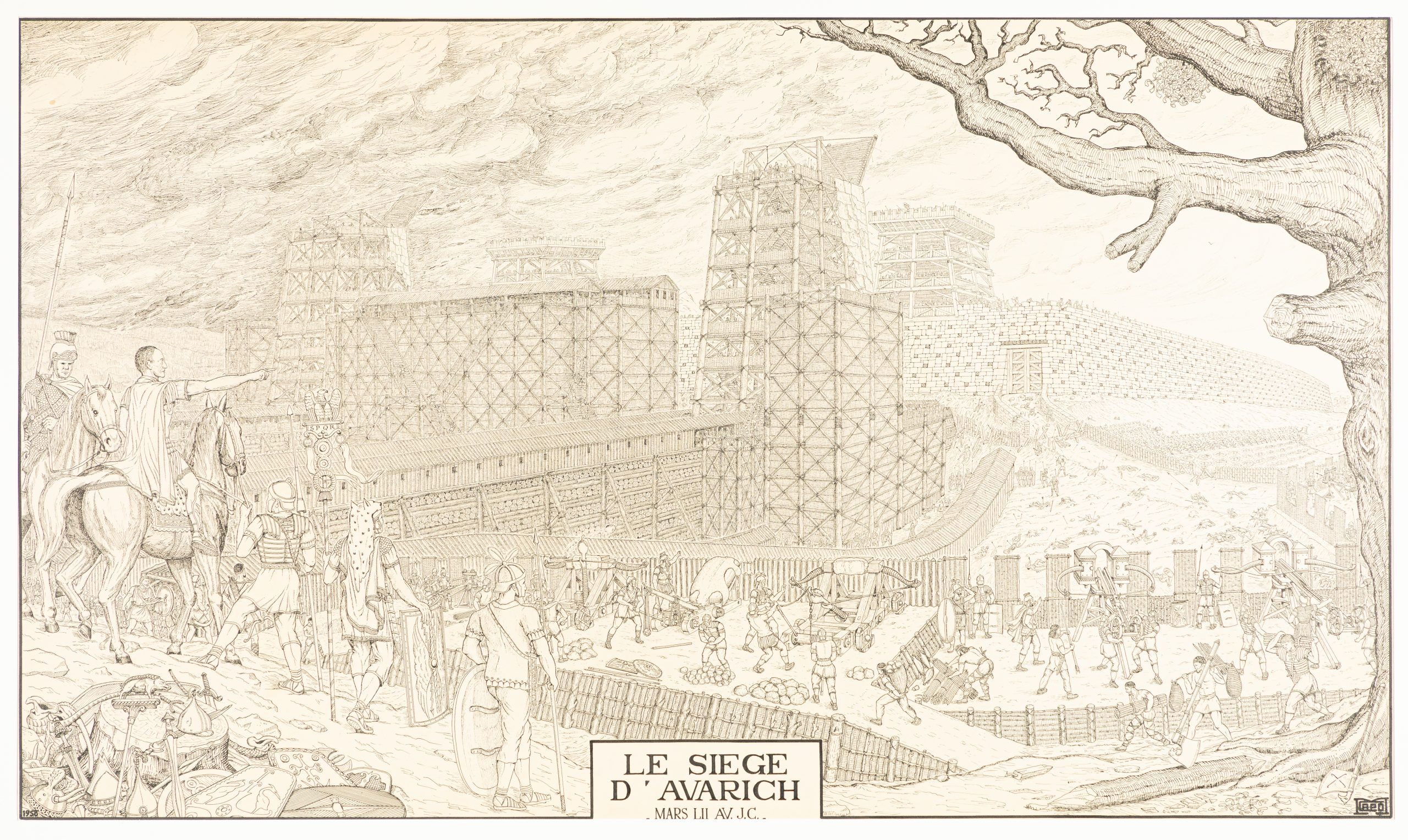
Michel Capo
Bernard Capo
«The seat of Avaricum» ®
by Bernard Capo – 2025.
work from the album
The Grand Hours of Bourges,
BulleBerry Editions.
To go further
Long before becoming the city we know today, Bourges was named after Avaricum. The capital of the Gaulish people of the Bituriges Cubes, this city occupied an important place in ancient Gaul. His history, marked by prosperity, war and transformation, is known to us thanks to the account of Julius Caesar in The Gauls' War and archaeological discoveries made on the Berruyer territory.
To better understand this founding period, three key moments allow us to trace the history of Avaricum: the birth of a large Gaulish city, the siege led by the Roman legions in 52 B.C.E., then the transformation of the city after its conquest and the birth of the ancient Bourges.
Avaricum, a major Gaulish city
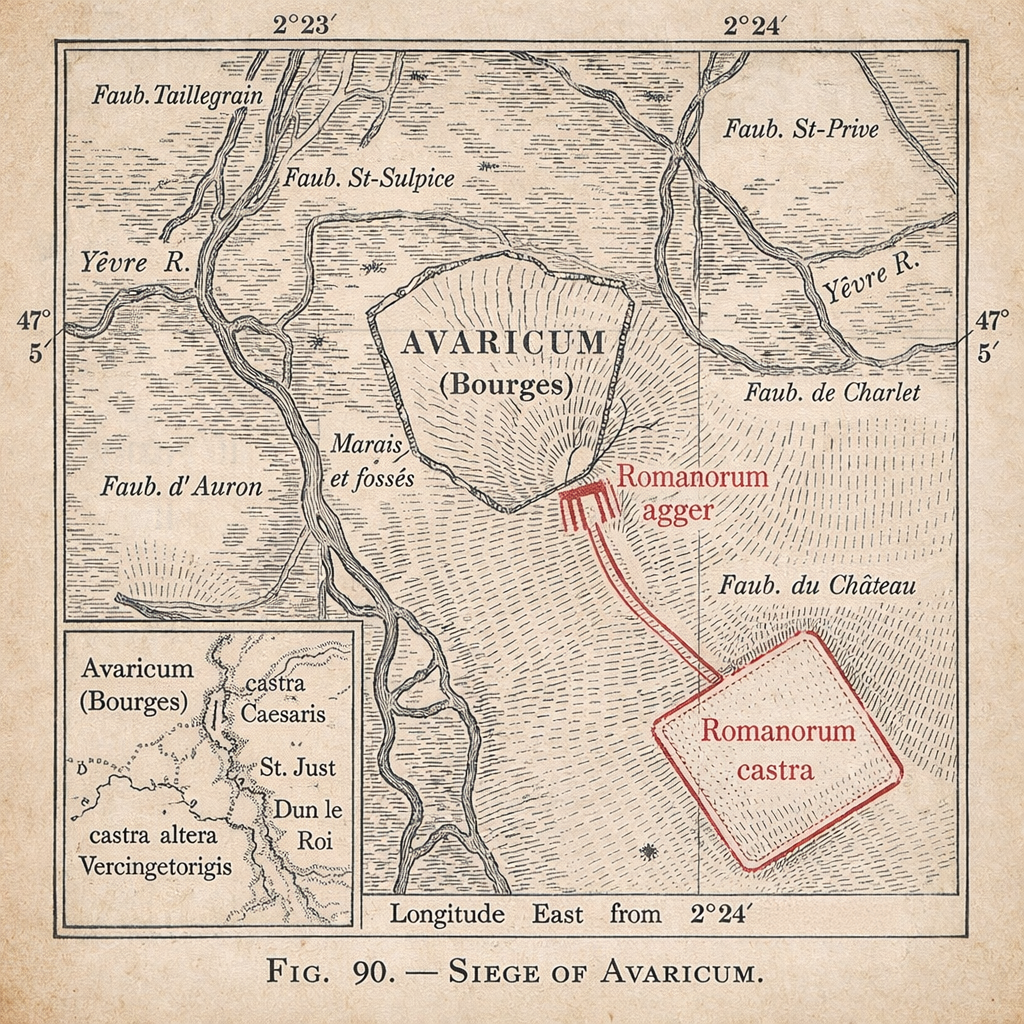
In the first century B.C.E., Avaricum — Current Bourges — is the capital of the people of Bituriges Cubes. The city occupies a privileged position on a height between the Auron and Yèvre valleys, whose marshes provide effective natural protection. This settlement, which favours both habitat, trade and defence, contributes to the development of an important agglomeration long before the Roman conquest.
Archaeological discoveries attest to an ancient occupation of the site, from prehistory to Iron Age. In the Gaulish era, Avaricum already appears as a structured and prosperous city. The remains found in various areas of the city, especially near Littré College or in the tombs of Lazenay, testify to the importance of this installation and its exchanges with the Mediterranean world. In La Guerre des Gaules, Julius César describes Avaricum as one of the most beautiful cities in the whole of Gaul, highlighting its major role within the Bituriges territory.
The seat of Caesar's legions
In 52 B.C., in the context of the great Gaulish revolt led by Vercingetorix, Avaricum became one of the main objectives of the Roman legions. The Arber chief then advocated a strategy of the burned earth in order to prevent the Romans from refuelling. Yet the inhabitants of Avaricum refuse to abandon their city. Confident in the strength of their ramparts and in the protection offered by the surrounding swamps, they choose to resist.
Julius Caesar then undertook a long and methodical siege. The Romans deployed all their mastery of military engineering: war machines, assault towers and gigantic ramps were built to reach the Gallic fortifications. The defenders oppose fierce resistance, burning Roman works and launching projectiles and features from the ramparts. This siege, described precisely by Caesar himself, illustrates the intensity of the confrontations that mark the conquest of Gaul.
The fall of Avaricum and the birth of ancient Bourges
After several weeks of fighting, the Roman legions finally managed to enter the city. The taking of Avaricum then turns into a tragedy: according to Caesar's account, the population is almost completely massacred. The Gallic poppidum, protected by its rampart of type murus gallicus, disappears almost entirely following this episode.
On the same site, a monumental Roman city develops, organized according to the principles of ancient urban planning. Avaricum has temples, thermal baths, an amphitheater, a cryptoportico, as well as water pipes and fountains. From the 1st to the 3rd century, the city was one of the major towns of the Roman Gaul. Over the centuries, the city changed, retracted behind new walls and gave birth to the medieval then modern Bourges. Thus, despite its destruction, Avaricum remains the historical base on which the present city was built.
Small lexicon of the seat of Avaricum
Gallic fortified city installed on a height and protected by ramparts. Avaricum was a major oppidum of the Bituriges Cubes people.
Type of Gallic rampart described by Julius Caesar. It consisted of a structure mixing wood and stones, particularly solid and difficult to destroy.
Roman military camp. The legions established fortified camps organized according to a specific plan to protect soldiers and organize siege operations.
Assault ramp built by the Romans to reach the ramparts of a besieged city. At Avaricum, Caesar built an immense agger to enable the legions to reach the Gallic fortifications.
Mobile seat tower used by the Romans. It allowed soldiers to reach the height of the ramparts and attack defenders from a high position.
Roman war machine capable of throwing projectiles at long distances, often features or stones. It operated thanks to a twisting system.
Seating machine used to project heavy stones against enemy ramparts. His name comes from the violent movement of his arm which recalls the kick of a onagre (wild donkey).
Roman military formation where soldiers brought their shields together to form a collective protection, similar to a turtle shell.
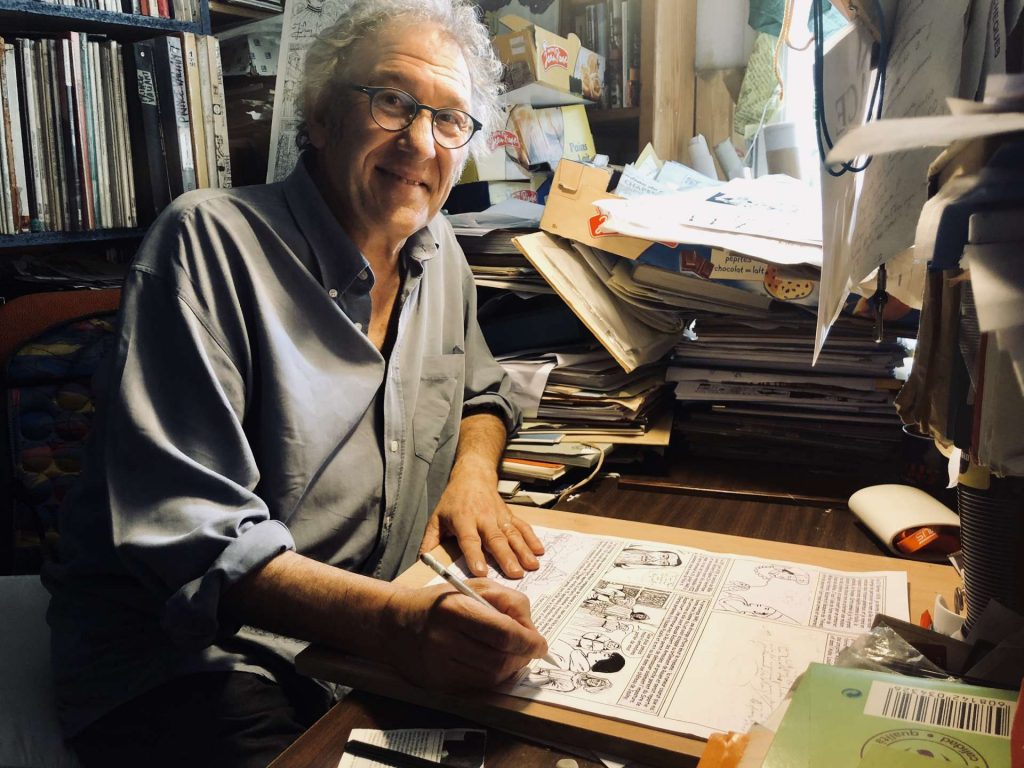
Bernard Capo
Born on 1 June 1950 in Bourges, in the medieval street of the Urbets, Capo grew up in a large family where cultural and artistic influences were mixed. His father, an industrial and bibliophile cartoonist, and his family environment feed his taste for design and creation very early.
After a childhood spent in the Bourges neighbourhoods and an education at Marcel-Sembat school and then at Alain-Fournier high school, he developed a real talent for drawing. At the end of his studies and after a visit to the Air Force in Avord, he undertook several trips around the world – from Scandinavia to Morocco, Turkey, Greece and Israel, where he lived for several months in a kibbutz.
Back in France, he multiplied his professional experience before fully devoted himself to his artistic passions. A singer-songwriter from adolescence, he wrote many songs and performed on stage, notably during the Printemps de Bourges.
At the same time, he returns to drawing and invests in comics. He participated in the creation of the Association for the Centre's Drawing Strip, conducted workshops and published his first boards in a fanzine. His career took a decisive turn when his comics The King of Heart, inspired by Bourges, is published by the Lombard and appears in the famous Tintin newspaper.
Since then, Capo has published more than forty albums and regularly participates in festivals, meetings and workshops with different audiences. Between passion, work and pleasure to create, he continues a rich artistic journey, marked by drawing, comics... and always a particular attachment to music, its first inspiration.

