

BOURGES AT THE MILIETY OF THE XVI SIEEL
UNDER JEAN CHEN'S PINCEL
JEAN CHEN, a painter who passed by the École des Beaux-Arts de Bourges, settled in the city creating a gallery, and then started work on rebuilding the city at different times, combining artistic quality and seeking accuracy. If the rarity of old representations makes this approach more difficult, the assumptions to which it leads are credible.
This view of Bourges presents the city in the 16th century, after the « Great fire » of 1487 which led to the reconstruction of many buildings. Much of the more than four hundred log houses, apparent or sometimes masked by a coating, which remains, date from that time.
Bourges, an important city from the Gaulish era, then under the Roman Empire, experienced a new boom after entering the royal domain in 1100.
A second bulwark was built at the end of the 12th century, covering, as can be seen from the work, almost all the buildings, the suburbs being of little importance.
More than fifteen thousand inhabitants resided there, which was enough to make it one of the twenty main agglomerations of the kingdom.
While the houses were tight against each other in the busy, artisanal or commercial streets, large unbuilt spaces remained occupied by gardens or marshes.
The upper city, inside the walls of the fourth century, gathered the main religious buildings, cathedral or Sainte-Chapelle.
As the seat of a large archdiocese, Bourges had about fifty places of worship, including about fifteen parishes.
In the following centuries the convents of the Counter-Reform were added. In the first half of the 16th century, the city rose from the fire of 1487, and the constructions multiplied, sometimes still Gothic (WASTE HOTEL), sometimes already Renaissance (CUJAS HOTELS AND LALLEMANT).
It benefited above all from the presence of a UNIVERSITY which attracted students from all over Europe and which made its reputation, thus succeeding the textile industry which symbolized, through THREE MOUTONS, THE WEAPONS OF THE CITY.
If the kings moved away, favoring the Loire Valley, then Paris, Bourges probably knew its peak, until the end of the 16th century.
It is this moment that JEAN CHEN wanted to represent here, this city where the « FOSS OF THE ARENES » Romanesque, dominated by the Gothic cathedral, populated by noble or bourgeois families as well as by many winemakers, and which then radiated artistically as well as intellectually.
Philippe GOLDMAN

South-West view of Bourges in the 16th century
Watercolor on wooden panel: 250 x 121.5 cm
2015
Private collection
Artist: Jean Chen
When the walls tell...
With Jean Chen we designed a course for those curious to learn more about the city's past. Once you have found the place, a QR code will allow you to discover its history.
*Legends texts by Philippe Goldman © Philippe Goldman, Bourges over the centuries, Editions La Bouinotte, Châteauroux, 2017


South-West view of Bourges in the 16th century

St. Stephen's Cathedral
The Gothic cathedral was raised from the end of the XIIe century, in 1195 maybe, location of several successive shrines. The two side Romanesque portals may have belonged to an earlier building, or they were reused despite the change of architectural party. A pillar has come to support the tower south to the XIVe. Then were created side chapels to the XIVe and XVe centuries.
The North Tower collapsed in 1506 and was rebuilt with the gates that it surmounted before 1540. In XVIe One still saw a small arrow above the cross of the false transept. The restorations of the XIXe added pinnacles and guards to the upper parts to do more « Gothic ». Bourges Cathedral is remarkable for its unique interior volume, without transept, and for the five majestic portals of its facade, extended by five naves. It has magnificent XIII stained glass windowse, XVeand XVIe centuries. In the lower church are presented the remains of the Gothic Jube demolished in XVIIIe, and the tomb of the Duke Jean de Berry from the Sainte-Chapelle, as well as stained glass of the same origin.
Very beautiful wall paintings of XVe century were discovered recently in the chapel Saint-Jean-Baptiste. One of the first UNESCO World Heritage sites, it is the most beautiful monument in Bourges, with its unique architecture and magnificent stained glass windows. By its situation, its volume and its elevation, it dominates the whole city. « in the shadow of the cathedral ».


The Ducal Palace
The Duke Jean built one of the most beautiful French palace ensembles between 1380 and 1410. It was composed to the south of a small palace housing the living rooms (location of the Prefecture), then two halls of appartment, of which remains, strongly restored, the room of the Duke Jean.
Then came the Great Hall, of gigantic dimensions, 52 m long and perhaps 35 high under frame. It was accessed by a monumental walk up to the Galerie du Cerf, which opened on the Grande Salle but also, perpendicularly, on the Sainte-Chapelle built like that of Paris. This architectural masterpiece was destroyed in 1757 following a hurricane.


The Holy Chapel
Like the one in Paris she inspired, the Sainte-Chapelle de Bourges was very largely glazed. Some of the windows are now visible in the crypt of the cathedral. Between the windows, statues of prophets were placed on columns. Some are at the Berry Museum. In the center was the tomb of Duke John, who was also transported to the cathedral.
The base was decorated with forty weeping, a first series carved in marble by Jean de Cambrai during the duke's lifetime, the others in alabaster, 40 years later, by Bobillet and Mosselman. There remain 26, scattered in museums around the world, as far as New York and St. Petersburg.
The Palais Jacques Coeur
No doubt the most famous building in Bourges with the cathedral, « large house » Jacques Coeur represents the most beautiful example of French urban architecture of the XVe century. Raised in the middle of the century precisely by the « great silver » just before its disgrace, it leans, like a medieval castle, with its powerful towers, on the Roman rampart, just like the Ducal Palace, but it opens on the other side of the city as a real palace. A beautiful courtyard lined with galleries lies between these two parts.
Another gallery, missing, extended the house to the south. Inside, you can still admire monumental chimneys and very beautiful ceilings in overturned hull, as well as the rich sculpted decoration of the towers and painted vaults of the chapel, which constitute one of the masterpieces of the French painting of the middle of the XVe century.
A rare civilian stained glass window showing silverware has also been preserved. On the other hand, the equestrian statue of Charles VII, which stood above the entrance of the facade, disappeared at the Revolution, which was spared to the two characters framing on both sides, tied to windows, and which probably represented Jacques Coeur and his wife Macé de Léodepart.


The Arenas
Bourges had a Roman amphitheatre, certainly also one or the theatres, but of which nothing is known. The amphitheatre was partly preserved until the beginning of the 17th century.e century, when what remained was filled to create a market place.
These « arenas » had been largely dismantled since the IIIe or IVe century, when building the rampart that used stones. For the XVIeThere are two types of information: « Arena pit » It was used as a dump; on the other hand, it welcomed a gigantic representation of the mystery of « Acts of the Apostles » in 1536. But we do not know exactly what remained in elevation, above the « pit », and reconstitution is therefore a proposal, which can be discussed.
The Remparts
Two enclosures were built to protect the city. The first was in the IIIe or IVe century, shortly before the great invasions. It reduced the Roman city to a limited enterprise, 25 hectares, on the upper part of the hill. The walls were based on large blocks from disassembled monuments, surmounted by a small brick reinforced apparatus.
At the end of the XIIe A century ago, Philippe Auguste's enclosure included a large area of 110 hectares, including suburbs and large unbuilt spaces. A powerful fortress, the Grosse Tour, with a dungeon similar to the Louvre, strengthened it and also allowed the king to control the city. It was destroyed after the Fronde, a joint will of the king and the inhabitants.
The Roman rampart created a high city, « Hypercentre » and XIIe a low town girded today, not by the wall, but by the boulevards. An important part of the Roman rampart remains, supporting the hotels of the upper city, while only two towers of the medieval wall have been preserved.


Churches
In the 16th century, there were about fifty places of worship, parish or collegial churches, priories, abbeys, convents, chapels... not to mention private chapels. The old views of Bourges show many steeples rising above the rampart, some built or enhanced at that time. the city was divided into fifteen parishes, of varying importance, which structured all social life.
Each had its own small cemetery, while the poor were buried in the « Large cemetery » then in the « Cemetery of the Poor ». The main abbey, Saint Sulpice was built extramural, surrounded by mills and some houses. The other abbeys or convents occupied considerable grips in the urban fabric, expected to increase further in the seventeenth century with the new establishments of the Counter-Reform.
The Church of Our Lady
A church named Saint-Pierre-le-Marché was built in XIIe century, and it is certified as a parish in XIIIe, dependent on the powerful nearby abbey of Saint-Ambroix. One « old pig market » Indeed, it was next door, and the section of the drapery, the main economic activity of Bourges in the Middle Ages, surrounded: rues des Toiles, de la Parerie...
It was rebuilt after the great fire of 1487, following an irregular plan. The south gate was decorated in the middle of the 16th century, and the frame was rebuilt in the 17th century. The church keeps in particular a window of the end of XVe century and a marble bentier of 1507. After the Revolution, it remained a parish church, but under the new name of Notre Dame.


The Church of Saint Peter the Guillard
If tradition claims that it was built on the occasion of the passage to Bourges de Saint Antoine de Padua in 1225, the church of Saint Peter the Guillard is actually older, since it is attested in a document as early as 1164. It was one of the most populated parishes in Bourges because it encompassed much of the district of Auron and a large extra-mural rural area. The current building dates from the second quarter of the XIIIe century.
The beautiful three-vessel nave is preceded by a square bell tower. Chapels added to the XVe century. Some remains of stained glass and wall paintings of the XVIe are still visible. Near the bedside, in the cemetery stood the small chapel of Saint-Antoine, attested to the XIVebut rebuilt by the Bread family at the end of the XVe – hence the name of chapel of the Breads – and shot down at the Revolution.


The Church of Saint-Bonnet
It's probably in XII.e A century that the powerful abbey of women of St. Lawrence created Saint-Bonnet Church, which became the seat of a densely populated parish. In 1513, architect Guillaume Pellevoysin drew up a plan for the new building to replace the one that had been largely destroyed by the 1487 fire. For lack of means, it was reduced to a nave of three spans, but with chapels.
The old bell tower was shot down in 1806 and the façade and remains of the church of XVe In 1898, it was destroyed and replaced by a new façade in 1933. Saint-Bonnet is today famous for its magnificent XVI stained glass windowse century, especially those due to Jean Lécuyer, one of the greatest French glassmakers of his time.


La Grange au Dimes
It was probably in 1264 that the cathedral chapter acquired a house with towers and a plot of land to install the attices to accommodate the wheats paid for under the tithe. The attices were probably previously on the other side of the street, which was itself opened at the end of the XIIe or XIIIe century. The « press and attics of the chapter » So they were built just after the acquisition. The press for pressing the grapes, also provided under the tithe, was installed on the ground floor, in a magnificent vaulted room.
The grains were stored on the floor, under a structure which was re-established in the XVIIe century. This building passed from hands to hands in the XIXe, and housed in particular a passage barracks, before becoming municipal property on the occasion of the separation of the Church and the State. He doesn't take the name of « Grange of tithes » as at XIXe century.


Hotel-God
According to tradition, the first Hôtel-Dieu de Bourges had risen near the cathedral since the early Middle Ages. But it has been attested only since the end of the 12th century. At the beginning of the 16th century, he was transferred to a new building, built on purpose, rue Saint-Sulpice, today rue Gambon.
This site had several advantages, and in particular the space that allowed three successor buildings to be installed: a high chapel, a long hall for the sick, a kitchen and, behind, the cemetery of the poor, while the small river of Yevrette evacuated the wastewater. We have the chance to have almost all the construction accounts, from 1510 to 1527, which inform us about the construction site, led by Philippon Boulot.
In the 17th century, two pavilions were added by Jean Lejuge. Used until 1995, the Hôtel-Dieu has since been the object of a restoration highlighting this magnificent example of medieval hospital architecture.


Hotel Cujas
It is a Florentine merchant based in Bourges, Durant Salvi, who built between 1508 and 1515 a unique hotel in Bourges, made of bricks and stones, a method previously unknown locally and which was not supposed to be posterity. One of his later owners, the great lawyer Jacques Cujas, is an illustrious figure of the University, which lived there in 1586-1590, left him his name. After being the gendarmerie in particular, it has been home since the end of the 19th century.e century the museum of Bourges (« museum of Berry »).
Various buildings, including a house body or a gallery on the street, disappeared and replaced by a simple wall, are ordered around two courtyards, including the court of honor with a rich still partially Gothic decor but also largely Renaissance (Arcades, medallions...). Especially visited for its collections, the Hotel Cujas is a too unknown flagship of 16th century architecture.


Hotel des Échevins
A city that entered the royal domain as early as 1100, Bourges did not have strong municipal power. The prudmen of the city gathered in a priory to deal with common affairs.
Only on the occasion of the great fire of 1487 did the aldermen decide to buy land to build the first town hall. It was built in a few years on the Gallo-Roman rampart, as was the Ducal Palace and Jacques Coeur's hotel from which it was inspired – modestly – with its widely decorated staircase turret. Several expansions took place, a street tower, then a beautiful arcade gallery built in 1624 by architect Berruyer Jean Lejuge.
In 1682 the elected representatives moved to the Jacques-Cœur Palace and the former Echevins hotel was included in the Jesuit college and later in the high school. It was finally transformed into a museum to welcome the work of Maurice Estève, great painter of the XXe century of Berrichonne origin.


Hotel Lallemant
On a difficult terrain, on horseback on the Gallo-Roman rampart, the Lallemant family, rich merchants and royal officers, built at the end of the XVe century a magnificent Renaissance hotel to the location of several houses, and overlooking two streets. It has two courses, and a vaulted passage leading from one to the other. The hotel is remarkable for the quality of its decor, perhaps partly the work of Italian sculptor Antoine Juste.
To medallions and other exterior ornaments, it is necessary to add a very beautiful interior decoration, in particular the famous ceiling with caissons of the chapel, which inspired extravagant pseudo-alchemical interpretations, while it clearly falls within the emblem then in vogue. The well-restored Lallemant Hotel is today the beautiful setting of the Museum of Decorative Arts in Bourges.


Houses in wooden strips
While stone houses were attested to in the Middle Ages, some of which remained, most of the houses used wood and torchi. There are almost no houses left before « Great fire » which destroyed a third of the city in 1487, but more than 400 are still standing, sometimes masked by coatings, more and more often unobstructed and restored, dating back to many of the ten or twenty years after the fire. The most frequent plan was a fairly narrow strap, with gable on the street.
A side corridor led to a courtyard, where a gallery went to the kitchen, distant for security. The stairs, the « Screws », was sometimes in the driveway, sometimes in an hors d'oeuvre tower on the rear façade. One of the dropural walls was most often made of stone, carrying the stumps of chimneys, to, again, limit the risk of fires. The problems of stormwater flow led later to the return of most roofs, thus removing the gables on the street.
Similarly, the ground floor was rebuilt in stone in the 18th century.e century, for more solidity.


Jean CHEN
Jean Chen is a contemporary French painter from Taiwan. He has lived in Bourges since 1997 where he has developed a remarkable artistic career by combining the cultural influences of the East and the West.
He is responsible for the Galerie Art Tension and has participated in several cultural projects and exhibitions, including the Musée des Beaux-Arts de Bourges.
In 2012-2013, Jean Chen began work to restore the city of Bourges as it was at its peak in 1487. It uses watercolor technique and large format. It presents a representation of the city seen from the sky, mixing a surgical precision of architectural details with a poetry of light and color.
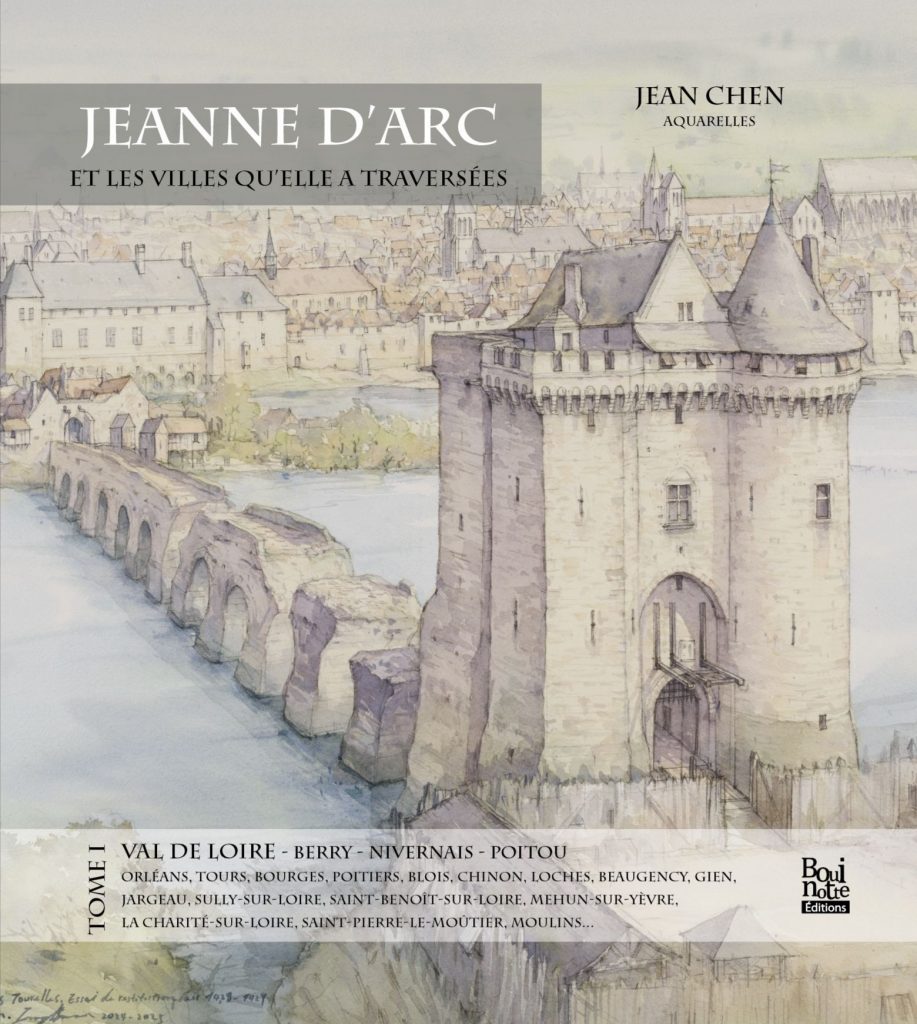
JEANNE D
AND CITIES THAT HAVE BEEN TRAVELED
TOME 1
The Loire Valley
By Jean CHEN
Bouinotte editions
23 March 2026
The book event
JEANNE D'ARC AND THE CITIES THAT HAVE TRAVELED TOME 1
After two books devoted to Bourges and Berry, Jean Chen began to follow in the footsteps of Joan of Arc, a twelve-year-old work. In two books, the first of which has already been published, he reconstructs all the cities where she passed during her ride of 1429/1431. A reconstruction of France from the 15th century and a tribute to Joan of Arc.

